
Bespoke vs Off-the-Shelf Software: Which Is Right for Your Business?
Bespoke vs off-the-shelf software compared: costs, time to launch, fit, ownership and risks, plus a simple scoring method to decide whether to buy, build or combine both.
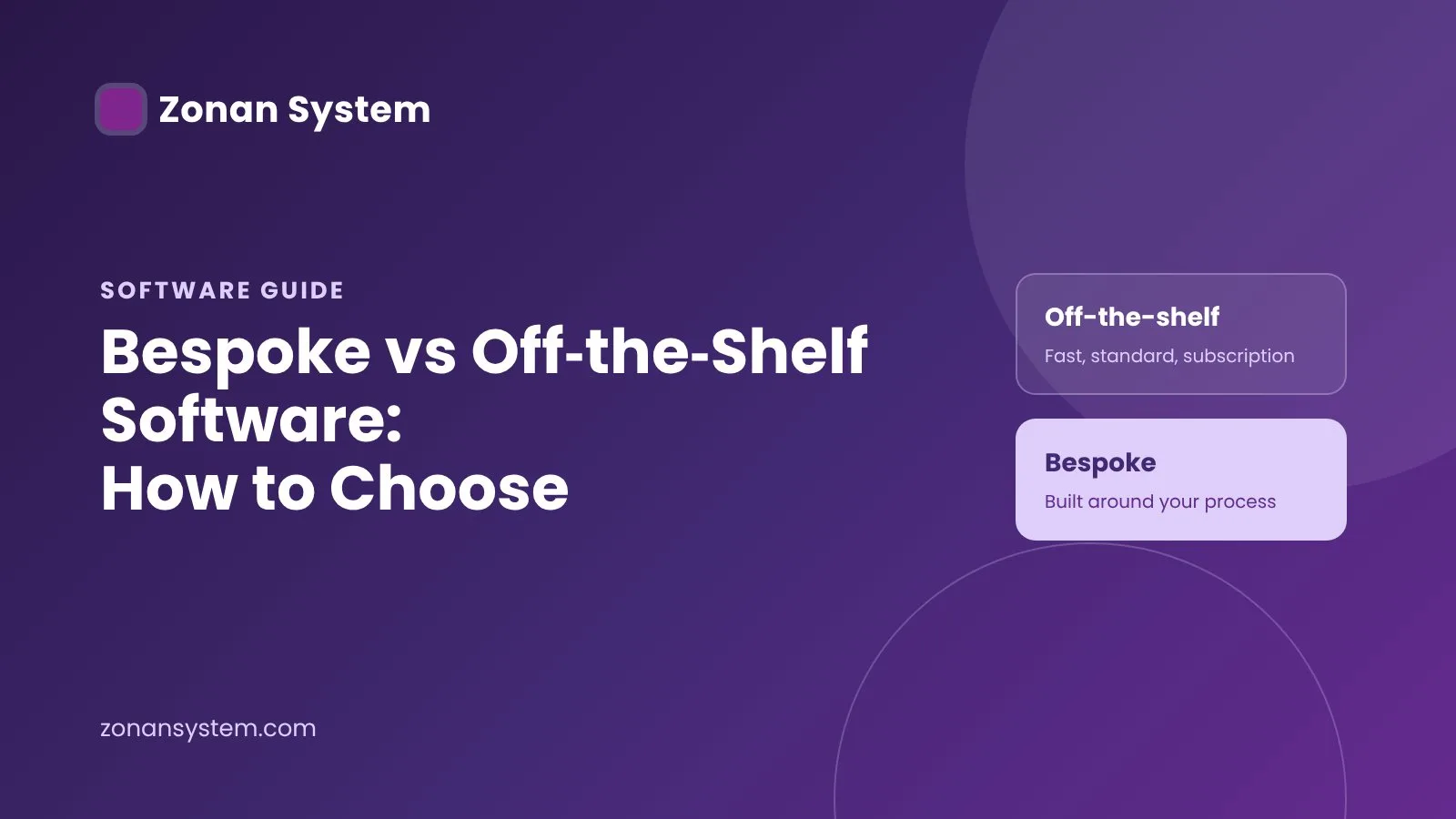
Every growing business reaches the same fork in the road. The spreadsheets have stopped coping, the team is copying data between three systems and someone asks the obvious question: should we buy a software package, or have something built for us? Choosing between bespoke vs off-the-shelf software is one of the most expensive technology decisions a small or mid-sized company makes, and it is often made on instinct rather than evidence.
This guide sets out what each option really means, where each one wins, the costs that are easy to miss and a simple scoring method you can use in your next planning meeting. It is written for owners, operations managers and directors rather than developers, so there is no jargon you need to decode first.
Key takeaways
- Off-the-shelf software is faster and cheaper to start with, and it is usually the right choice when your process is standard.
- Bespoke software costs more up front but fits your workflow exactly, and it pays off when the way you work is what sets you apart.
- Compare total cost over three to five years, not the first invoice: licences, workarounds and integrations add up.
- A hybrid approach — a ready-made core plus custom integrations or modules — is often the most sensible middle path.
- Whichever route you choose, insist on owning your data, and on owning the source code if you commission bespoke work.
What is off-the-shelf software?
Off-the-shelf software (sometimes called packaged, commercial or "COTS" software) is a ready-made product designed for many customers with similar needs. You sign up, configure it and start using it. Most modern examples are SaaS products paid for by monthly subscription: accounting packages, CRMs, booking tools, project management apps and so on.
The supplier spreads the cost of development across thousands of customers, which is why the monthly price can be low. The trade-off is that the product is designed around the average customer. You adapt your process to the software, not the other way round.
What is bespoke software?
Bespoke software, also called custom software, is designed and built for one organisation. A development team studies how you work, designs the screens, data and rules around that, and builds an application that you normally own outright. It might be a customer portal, an internal operations system, a booking platform with your own pricing rules or an AI assistant connected to your own data.
Because nothing is shared, you pay for the full design and build yourself. In return, the software does exactly what your business needs, integrates with the systems you already use and can evolve as you grow. If you want to see what that process looks like in practice, our page on custom software development explains how a typical project runs from discovery to launch.
Bespoke vs off-the-shelf software at a glance
The table below compares the two approaches on the factors that usually decide the matter. Treat it as a starting point: the right answer depends on your process, your budget and how central the software is to your business.
| Factor | Off-the-shelf software | Bespoke software |
|---|---|---|
| Upfront cost | Low — usually a subscription and some set-up time | Higher — you fund design, build and testing |
| Time to start | Days or weeks | Weeks to months, often delivered in stages |
| Fit with your process | Good for standard processes; you adapt to the tool | Built around your workflow, rules and terminology |
| Integrations | Limited to the connectors and APIs the vendor offers | Designed to connect to your existing systems |
| Scaling costs | Per-user or per-feature pricing grows with your team | Mainly hosting and maintenance; no per-seat licence |
| Ownership and control | The vendor owns the product and the roadmap | You normally own the code and decide what comes next |
| Competitive advantage | Competitors can buy the same tool | Can support a process that rivals cannot easily copy |
| Maintenance | Handled by the vendor, on the vendor's schedule | Your responsibility, usually through a support agreement |
| Main risk | Workarounds, lock-in and price rises | Poor scoping, an unreliable supplier or an unclear owner |
When off-the-shelf software is the right choice
Buying is usually the better option when most of these statements are true:
- Your process is standard. Payroll, bookkeeping, email marketing and basic appointment scheduling work much the same way in most businesses. There is little to gain from reinventing them.
- You need something this month. A subscription can be live in days, which matters when the alternative is losing customers now.
- The budget is tight and the requirement is small. A handful of users with simple needs rarely justifies a custom build.
- Regulation is handled for you. For areas such as tax filing, a reputable vendor keeps the product aligned with rule changes so you do not have to.
- The software is not what makes you different. If customers do not choose you because of how this process works, a good-enough tool is good enough.
Ready-made does not have to mean generic, either. Zonan System offers subscription products such as a CRM, an online booking system and accounting software for small businesses — you can compare them on our plans and pricing page — precisely because many companies simply need a dependable tool that works from day one.
When bespoke software makes more sense
Custom development starts to pay back when the cost of fitting your business into someone else's product becomes higher than the cost of building your own. The common signals are:
- Your team relies on workarounds. Spreadsheets alongside the "official" system, duplicate data entry and manual exports every Friday are all hidden costs.
- Your process is your advantage. A unique quoting method, a specialised service model or a distinctive customer experience should not be flattened to fit a template.
- You need several systems to talk to each other. When orders, stock, finance and customer data live in different tools, a custom layer can join them up. Often this is a job for workflow automation rather than a whole new system.
- Licence costs are climbing. Per-user pricing that felt cheap for five people can become a significant line in the budget for fifty.
- You want to sell the software or build a product. If the platform is the business — a marketplace, a portal or a SaaS idea — you need to own it.
- You want AI that understands your business. General AI tools are useful, but an assistant that reads your own data, follows your rules and takes action in your systems needs to be built. Our article on the best AI tools for business covers where off-the-shelf AI stops and custom AI agent development begins.
The hidden costs on both sides
Comparing a monthly subscription with a development quote is misleading, because the two options spread their costs very differently. A fair comparison looks at the total cost of ownership over three to five years.
Hidden costs of off-the-shelf software
- Per-seat growth: every new hire adds to the bill, and higher tiers are often needed to unlock one essential feature.
- Integration add-ons: connectors, automation platforms and middleware each carry their own subscription.
- Workaround time: staff hours spent re-keying data or reconciling systems rarely appear in the budget, but they are real.
- Switching costs: exporting years of data and retraining a team is expensive, which gives vendors pricing power.
Hidden costs of bespoke software
- Discovery and design: good projects invest time up front to agree scope; skipping this is the most common cause of overruns.
- Hosting and third-party services: cloud hosting, email, SMS, payments and AI model usage all have running costs.
- Maintenance: security updates, framework upgrades and small improvements need an ongoing budget. Many teams plan for roughly 15–20% of the original build cost per year, although this varies widely.
- Internal time: someone in your business needs to own the project, answer questions and test the software.
For indicative budget ranges by project type, see our guide to custom software development cost. The figures there are planning ranges, not quotes, but they help you judge whether a bespoke build is realistic before you speak to anyone.
The hybrid option: buy the core, build the edges
The choice is rarely all or nothing. Many of the most cost-effective systems combine a reliable off-the-shelf core with custom pieces around it:
- A standard accounting package, connected by a custom integration to your own order system so invoices are raised automatically.
- A ready-made CRM, extended with an AI assistant that qualifies leads from your website and books calls.
- A bespoke customer portal that sits on top of existing back-office tools, giving clients one place to see orders, documents and invoices.
The hybrid route keeps upfront costs down while removing the workarounds that hurt most. It also lets you test demand before committing to a larger build. A well-designed web application can usually connect to existing tools through their APIs, so you do not have to replace everything at once.
A simple scoring method for your decision
If the discussion keeps going round in circles, score each statement below from 0 (not true at all) to 3 (very true) for the process you are trying to improve:
- The way we do this is a reason customers choose us.
- No product we have tried fits without significant workarounds.
- This process needs to connect to three or more other systems.
- We expect the number of users or transactions to grow considerably.
- We want to own and control how this software develops over time.
- We have someone who can own the project and make decisions quickly.
A total of 0–6 points strongly towards off-the-shelf software. A total of 7–12 suggests a hybrid approach: buy the core and build integrations or modules where the gaps hurt most. A total of 13–18 suggests bespoke software is worth a proper evaluation, starting with a short discovery phase. This is a rule of thumb rather than a formula, but it turns a vague debate into a concrete conversation.
How to reduce the risk of a bespoke project
Most failed custom projects fail for the same few reasons: an unclear scope, too much built at once and a supplier relationship without clear checkpoints. You can avoid most of that by following a few principles:
- Start with discovery. Map the process, agree the must-have features and get a scoped estimate before committing to a full build.
- Launch a focused first version. Deliver the features that create value now and add the rest once real users have tried it.
- Pay against working milestones. Ask to see working software regularly, not just progress reports.
- Own your code and data. Make sure the contract gives you the source code, the designs and full access to your data.
- Plan for support from day one. Agree how bugs, updates and improvements will be handled after launch.
- Choose the right partner. Our checklist on how to choose a software development company lists the questions worth asking before you sign.
Frequently asked questions
Is bespoke software better than off-the-shelf software?
Neither is better in every case. Off-the-shelf software is usually better for standard processes, small teams and urgent needs. Bespoke software is usually better when your process is distinctive, needs to connect several systems or is central to how you compete.
Is bespoke software always more expensive?
It is more expensive up front, but not always over its lifetime. When you add up per-user licences, add-ons, integration tools and staff time lost to workarounds over several years, a focused custom system can cost less overall. A three-to-five-year comparison is the fairest way to judge.
How long does it take to build bespoke software?
It depends on scope. A small internal tool or automation can take a few weeks, while a larger business platform is normally delivered in stages over several months. Releasing a first version early lets your team benefit before the whole system is finished.
Can off-the-shelf software be customised?
Usually only within limits. Most products allow configuration, custom fields and some integrations, and many have APIs. Deeper changes to how the product works are typically not possible, which is where custom integrations or a bespoke module come in.
Who owns bespoke software?
That depends on the contract. In most bespoke projects the client should own the source code and data once the work is paid for, but you should confirm this in writing before the project starts.
What is the difference between bespoke software and custom software?
There is no practical difference. "Bespoke software" is the term more commonly used in the UK, while "custom software" is more common in the US. Both describe software designed and built for a specific organisation.
Conclusion: decide by process, not by preference
The bespoke vs off-the-shelf software decision is not about which approach is more modern or more impressive. It is about which one removes the most friction from a specific process at a cost you can justify. Buy what is standard, build what makes you different and connect the two where it matters.
If you are unsure which side of the line your project falls on, Zonan System can review the process with you and recommend the simplest route — whether that is a ready-made product, an integration or a bespoke build. Book a free consultation, or read more about our bespoke software development service.
Zonan System Team
Software & AI team
Developers, designers and AI engineers at Zonan System, writing about practical AI, software development and digital business.
Need advice for your project?
Zonan System experts will guide you for free.
Comments (0)
Be the first to comment.