
Why Does Your AI Only Talk and Never Act? Enterprise AI Agent Architecture
Real business value arrives when AI moves beyond answering questions to taking controlled action in your CRM, ERP and other systems. Here is how enterprise AI agent architecture fits models, tools, data, workflows and people together.

Most corporate AI projects begin with a promising demo. A few documents are fed into the system, a manager asks one or two questions and receives answers that, only a few years ago, would have seemed impossible for software. The meeting usually ends with the impression that the company is not far from automating a good part of its work. But just as this impressive demo is supposed to become a real business tool, the core problem reveals itself.
Suppose the sales manager wants to find customers who have made significant purchases over the past three months but have not placed an order for more than 30 days. They do not just expect a list of customers. They want each customer's history reviewed, the most important customers prioritised and an appropriate follow-up logged in the CRM for the responsible rep. The request looks simple, but carrying it out requires information that is probably scattered across several different software systems.
Customer details and contact history may be in the CRM, purchase information in the online shop or sales software, and payment status in the accounting system. Some important information may even be sitting in reps' notes, Excel files or the transcripts of previous conversations. A language model can understand what the manager means, but understanding the request is only a small part of the job. The real question is how the system should find the information it needs, connect the dots and ultimately carry out a real operation in the company's software.
This is exactly where the line between a chatbot and an enterprise AI agent is drawn. The challenge is no longer producing a better answer; it is building a system that can move from "understanding" to "doing" within a defined and controllable scope.
An AI agent only makes sense when there is real work involved
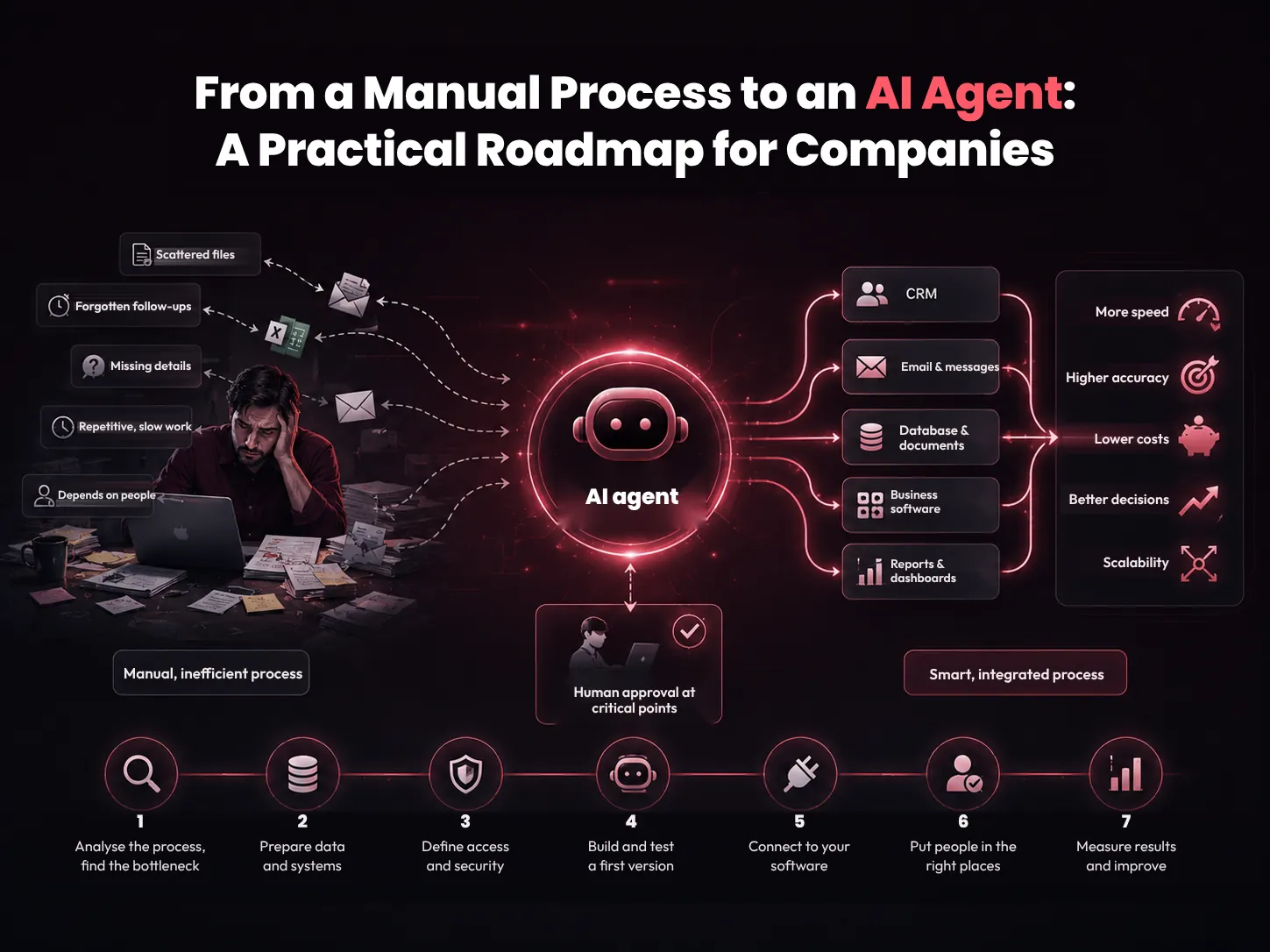
There are many definitions of an AI agent, but for a business leader a simpler definition may be more useful. An AI agent is a system that, in pursuit of a goal, does more than generate text: it can retrieve the information it needs from authorised sources, assess the situation, use the right tool and take action within the limits set for it.
The key difference lies in that "action". An ordinary assistant can review a conversation history and suggest that a customer should be followed up today. A sales agent, by contrast, can retrieve that customer's data from the system, summarise the latest negotiation, identify the account owner and log tomorrow's follow-up task in the system. If the architecture allows, it can even prepare a draft message so that the rep only needs to review it.
Of course, this definition should not lead us to the exaggerated image of a "fully autonomous digital employee". In a healthy enterprise system, more autonomy is not necessarily more of an advantage. In fact, an important part of agent engineering is defining what it can do, which information it cannot access, where it must stop and at what point it should hand the decision over to a person.
So a good agent is not necessarily one that can do more. Sometimes the best agent is a system with a limited responsibility that it carries out well, and which has almost no authority beyond that scope.
The main problem is usually not the AI model
In many early project meetings, the discussion turns very quickly to choosing a model. Which model is more accurate? Which one best handles the languages and terminology we work with? Which is cheaper? Should we use an external model or run one on the company's own infrastructure? All of these questions matter, but they are usually raised earlier than they should be.
Suppose we have the best model available, but the company's customer data is incomplete. Sales reps have not recorded opportunity stages correctly, the accounting software has no suitable API, and nobody can explain precisely the journey a lead takes from first contact to becoming a customer. In such circumstances, a more powerful model will not solve the fundamental problem.
An enterprise agent is really a software system in which the language model is just one component. Alongside the model, there must be usable data, tools defined for carrying out operations, different applications able to communicate with each other, clearly specified business rules and controlled access levels for each part. If any one of these pieces is poorly designed, a more powerful model will not necessarily produce a better result.
This is very important for businesses that want to embark on agentic projects. The hard part is not always "what answer the AI gives". Sometimes the hardest part is working out how the model's answer should become a valid operation in the company's system without causing chaos.
Connecting the agent to company software is where the project gets serious
Let us assume a company uses three main systems: a CRM for managing opportunities, an online shop for orders and accounting software for payments. The sales manager wants to find customers who have had high purchase value but have been inactive for a while.
To reach that result, the agent must be able to retrieve relevant information from several sources. This connection is usually made through APIs. But a technical connection alone is not enough. The more important question is exactly which part of each system the agent needs.
If it only needs to read a customer's latest order, why should it also be able to edit orders? If only the account balance is needed for the decision, what reason is there to allow it to post accounting entries? If the agent only needs to create follow-up tasks, why should it be allowed to delete customer data?
These questions may look like security questions, but they are fundamentally part of software design. A good architecture does not try to connect the agent to the entire system; it tries to give it the smallest path necessary to carry out a specific task.
In real projects, this stage usually takes far longer than simple AI demos suggest. Legacy systems may lack suitable interfaces, data may be messy, or a single concept may be defined differently in two applications. For example, an "active customer" in the sales department may mean something different from the same term in the finance system. Until these discrepancies are resolved, the language model has nothing to work with.
Good tools matter more than broad access
One smart decision in agent architecture is to build a set of narrow, well-defined tools for it rather than opening up systems directly. For example, one tool might only return a customer's purchase history, another might check payment status and a third might create a task for a sales rep.
In one sense this approach seems simple, but it has an important effect. When the "create sales task" tool only allows a title, a rep, a description and a date to be set, the agent cannot use that tool to delete a customer or change a contract, even if it behaves unexpectedly. The scope of capability is defined in the architecture itself — not in a polite request to the model to "please don't do anything else".
This is where software development comes back to the centre of the story. The quality of an agent does not depend solely on the model's reasoning ability; it depends on the quality of the tools built around the model. Vague tools, excessive access and a weak API can turn a good model into an unreliable system. Conversely, narrow, clear tools can make the system's behaviour far more controllable.
That is why, when analysing a project like this, the Zonan System team looks at the real flow of work before choosing any technology: what users do today, which applications they move between, which decisions genuinely require analysis and which operations are simply a deterministic software command.
Not every decision is worth handing to a language model
One sign of poor architecture is using a language model for almost every small decision. This not only increases cost and response time but also turns behaviour that could have been completely predictable into a probabilistic decision.
Suppose the company's sales policy states that any discount over 15 per cent must be approved by a manager. We do not need "intelligence" here. A simple software condition is fast, reliable and sufficient. But working out whether a customer's main concern in a recent conversation was price or delivery time is a different matter. This is where language and context analysis can be useful.
A mature architecture does not confuse these two worlds. Whatever follows a clear rule is executed through software and deterministic rules, while whatever requires language interpretation, classification or context analysis is handed to the model. The result is a system that becomes "intelligent" only where intelligence genuinely adds value.
This also has an economic effect. Every model call costs money, takes time and introduces a new point of failure. Using the model less, but more purposefully, is in many projects not a sign of falling behind but of better architecture.
More memory does not always mean a better agent
Memory is another area that is sometimes oversimplified in discussions about agents. The common assumption is that the more information the system retains from the past, the better it will perform. In an enterprise environment, that rule does not always hold.
If a customer's history is already recorded in the CRM, there is not necessarily any reason to create another copy of the same information in the "agent's memory". Doing so quickly creates a new problem: if the CRM data changes, which version is authoritative? If the customer asks for their data to be deleted, what happens to the information stored in memory? If two systems hold different information about the same customer, which should form the basis of the decision?
A good architecture tries to define a single source of truth for each type of information. Customer data may belong to the CRM, payment status to the finance system and product knowledge to the documentation system. The agent retrieves this information when needed, rather than necessarily building a parallel copy of the entire organisation for itself.
Memory is valuable when it is genuinely needed to maintain context between the steps of a process or related interactions. Even then, it must be clear what is stored, how long it is kept and who is allowed to access it.
Organisational knowledge is not only in the database
Another problem that surfaces very quickly is that a significant part of a company's knowledge is not structured at all. Contracts, internal guidelines, product descriptions, support procedures, technical files and organisational policies are usually scattered across different documents.
This is where information retrieval becomes important. Instead of expecting the model to "know" all of the company's knowledge, the system can find the relevant part of the authoritative documents when carrying out a task and provide it to the model. Architectures such as retrieval-augmented generation (RAG) are used for exactly this purpose.
But a conceptual boundary must be maintained. Finding information is not the same as doing the work. A retrieval system may find the refund clause in the company's policy; after reading that clause, the agent may check the order status and route the case accordingly. One makes knowledge available; the other brings that knowledge into an operational process.
This distinction becomes important when deciding how much autonomy the system should have.
Without a defined workflow, an enterprise agent soon becomes unpredictable
There is an appealing picture in which an agent is given a general goal and the system works out all the steps to reach it by itself. For experimentation and some low-risk uses, that freedom can be interesting. But in important business processes, unlimited freedom is usually not what a technology leader is looking for.
Suppose the issue is a customer refund. The company's process probably has defined steps: the order must exist, the refund conditions must be checked, the delivery status must be known, the amount must be calculated and, in some cases, a manager must approve. It makes no sense to ask the model to reinvent this process from scratch every time.
The more controllable approach is for the main workflow framework to be defined in software, with the model coming in only at points that genuinely require analysis — for example, classifying the text of a customer complaint, extracting the reason for the request or spotting an unusual case. The rest of the journey follows the business rules.
In this way, AI does not replace the process; it sits inside the process.
Where exactly do people remain in this architecture?
The goal of a good project is not necessarily to remove people. In many processes, the main value lies in freeing people's time from repetitive work so they can focus on decisions that genuinely require judgement.
A sales agent can gather a customer's history, summarise conversations and suggest the next action, but an unusual discount should go to a manager. A contracts agent can find non-standard clauses, but accepting legal risk remains with the responsible person. A finance system can detect a discrepancy, but a significant payment should not be made without approval.
The right boundary differs for every organisation, but there is a useful rule: the more irreversible, financial, legal or security-related an action is, the more reason there is for a person to remain at the point of decision.
Contrary to first impressions, this approach does not reduce the value of automation. If the system can do 90 per cent of the work of preparing a decision and hand only the sensitive 10 per cent to the responsible person, a large part of the process time has still been eliminated.
Security becomes serious the moment the agent is able to act
As long as a system only produces answers, its errors often stay on the screen. But once it is connected to files, a CRM, a database or an API, the model's errors can have real consequences.
At that point, security is no longer a separate stage at the end of the project. The access level of each tool, where keys are stored, network connections, isolation of the execution environment, activity logging and approval of sensitive operations must all be built into the architecture from the start.
A sales agent that only needs to read customer data should not be able to delete it. An agent that only needs three specific services has no acceptable reason for unrestricted access to the entire internet. Sensitive keys should not be placed directly within the model's reach simply because it makes them easier to use.
We have covered this topic in more detail in our article on AI agent security: secure architecture from sandboxing to Zero Trust networking. The connection between the two discussions is no coincidence. The greater an agent's power to act, the more seriously its security architecture must be taken.
Does your business actually need an AI agent?
In today's technology landscape, the answer "no" is sometimes more valuable than "yes". Not every process needs an agent.
If a task is entirely well-defined and rule-based, ordinary automation will probably be simpler, cheaper and more reliable. If a report needs to be pulled from a database and sent to a manager at 9 a.m. every day, there is little reason to bring a language model into the process.
An agent becomes more attractive when work moves between several systems, some of the information is in the form of text and documents, decisions depend on context and staff spend a lot of time gathering information and choosing the next action.
But even when these conditions exist, it does not mean the project should start immediately. If the current process is unclear, the data is of poor quality or the company cannot say what measurable outcome it wants from the project, it is better to solve those problems first.
AI does not necessarily fix a disorganised process. Sometimes it merely helps that disorder run faster.
Where does the real cost of building an enterprise agent lie?
When people talk about the cost of an agent, attention usually goes to the cost of the model and the number of tokens. In enterprise projects, that is only part of the story — and sometimes not even the main part.
Most of the project's time may be spent connecting to legacy software that lacks a suitable interface. Cleaning up the CRM data may be harder than building the agent itself. Defining permissions, building secure tools, logging events and designing the human approval path may make up a significant share of development.
That is why two agents using the same model can have completely different development costs. One might simply read a few documents and create tasks in one system; the other might have to work with five applications, sensitive information and several organisational access levels.
A realistic estimate only becomes possible once the use case has been narrowed down sufficiently. Before that, asking "how much does it cost to build an agent?" is rather like asking "how much does it cost to build software?"
Where should you start?
The best starting point is usually a small but painful process: a task that is carried out regularly, takes up significant time and has a measurable outcome.
For example, the sales team may have to gather information from several sources every day to work out which customers need following up. Instead of building an "all-purpose sales agent", you can examine just this one process.
The current situation is measured. We establish how long the task takes today, what errors occur and what the desired outcome is. Then the data sources, necessary tools and decision points are identified. Only at this stage does it become clear where a language model is genuinely needed and where a simple API or rule will do.
The initial version is also best kept limited: a few users, a few tools and one defined scenario. If the results are good, the system's scope can be expanded step by step.
This is the approach Zonan System can start from for projects like these: not with the question "what agent should we build?", but by examining which part of the company's current work is worth making intelligent, and what architecture is genuinely needed to change it.
Conclusion: the gap between an impressive demo and a real system lies in the architecture
Building a system that answers a question well is no longer the hardest part. The real challenge begins when we expect that same system to work with the company's data, move between several applications and turn the result of its analysis into a real action.
At this stage, choosing the model is no longer the only important decision in the project. Data quality, tools, APIs, business rules, memory, workflow, security and the role of people all determine how useful the system will be in practice.
An enterprise AI agent creates value when we know exactly what it is responsible for and — perhaps more importantly — what it is not responsible for.
So before asking ourselves "how do we build an agent for the company?", there is a more precise question:
Which piece of work in the company is currently stuck between people, software and scattered information — and if part of it were made intelligent, what measurable outcome would it create for the business?
The answer to that question is usually the starting point for a project that is meant to be more than an impressive demo. If you would like to explore it for your own organisation, get in touch with us.
Frequently asked questions about enterprise AI agents
What is an enterprise AI agent?
An enterprise AI agent is software that, in addition to analysing information, can use specific tools to carry out a task. For example, it can read customer data from the CRM, review order history or create a follow-up task for a sales rep.
What is the difference between an AI agent and a chatbot?
A chatbot usually answers questions or provides information, whereas an AI agent can connect to authorised software and tools and carry out part of a real process. That is why designing an agent depends not only on the language model but also on data, software integration, access levels and workflow.
Can an AI agent connect to a company's existing software?
Yes. If applications such as the CRM, accounting software or enterprise systems have suitable interfaces for exchanging data, the agent can be connected to them. With older software, a custom interface or intermediary layer may be needed first.
When does a business genuinely need an AI agent?
When a repetitive, time-consuming process requires gathering information from several sources, understanding text or circumstances and choosing between several actions, using an AI agent can make sense. If the same task can be solved with a few fixed rules and simple automation, there is usually no need to complicate the system with an AI agent.
Zonan System Team
Software & AI team
Developers, designers and AI engineers at Zonan System, writing about practical AI, software development and digital business.
Need advice for your project?
Zonan System experts will guide you for free.

Comments (0)
Be the first to comment.