
AI Project Budgeting: How to Avoid Wasting Resources
Many AI projects struggle not because of the technology but because of poor budgeting. Learn the hidden costs, common mistakes and a staged approach to keep AI spend under control.
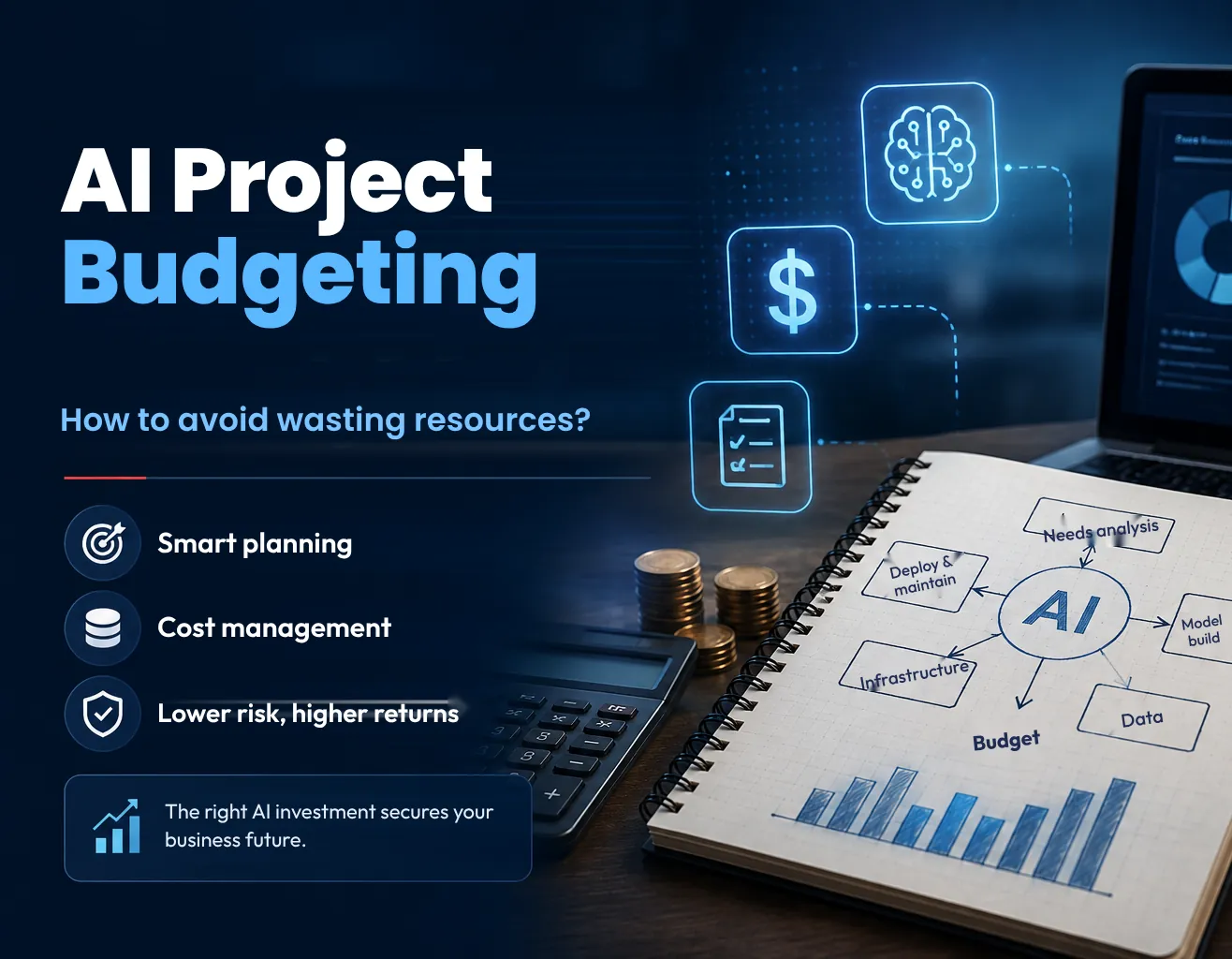
Why do so many AI projects run into budget problems from the very start?
Imagine you run a service company and have decided to use AI to improve your sales, support or data analysis processes. After a few meetings, the technical team presents various tools, trial versions are set up and the project gets off to an enthusiastic start. But a few months later, costs have exceeded the original estimate, the schedule has slipped and the question arises: "Was this investment even worth it?"
This scenario is familiar to many organisations. The main problem is usually not the technology itself; it is the lack of precise financial planning and a realistic view of the project's different dimensions. When estimating costs, many businesses focus only on developing a model or buying AI tools and overlook more important costs such as data preparation, integration with existing systems, user training, maintenance and continuous improvement.
What is more, unlike many software projects, AI projects depend heavily on the quality of the organisation's data and processes. If these two components are not assessed properly from the start, even the best AI models cannot deliver the desired results — which drives up costs and stretches out delivery times.
That is why budgeting for AI projects is not just about putting a number on the cost; it is a process of identifying needs, forecasting direct and indirect costs, managing risk and making informed decisions about how to invest.
Across many AI implementation projects, experience has shown that organisations which spend enough time analysing requirements and designing a roadmap before development begins face less uncertainty and fewer costly changes later on. That is why Zonan System treats the analysis and feasibility stage as one of the most important parts of any project, before any technical development takes place.
What exactly does AI project budgeting mean?
When it comes to budgeting for an AI project, many managers immediately think of the cost of buying software, developing a model or using AI APIs. The reality, however, is that budgeting for an AI project goes far beyond estimating development costs.
Budgeting for this kind of project means establishing from the outset what problem is to be solved, what resources are available, what infrastructure is needed and which indicators will be used to measure the project's success. In effect, budgeting is a management tool for controlling risk, not just a table of costs.
One important way AI projects differ from traditional software projects is their dependence on data quality, organisational processes and continuous change. So if the budget is based solely on software development costs, you may later face costs that were never anticipated.
Before making any financial decision, therefore, you need a clear picture of the project's path, the business goals and the resources required. The more carefully this stage is carried out, the lower the chance of costly changes later on.
Hidden costs of AI projects that are often overlooked
One of the main reasons AI project costs rise is the presence of costs that are not very visible at the start. These usually emerge once development is under way and, in many cases, affect the project's timeline and budget.
Data preparation
AI models do not perform well without high-quality data. In many organisations, data is scattered across different systems, lacks a consistent structure or is partly incomplete. Before a model is developed, the data must therefore be collected, cleaned and standardised — a process that sometimes takes longer than developing the model itself.
Integration with existing systems
AI does not create value on its own; it becomes valuable when it can communicate with your CRM, ERP, office automation, finance software or other organisational systems. If this is not considered in the planning from the outset, it will become one of the biggest challenges later in the project.
User training and change management
Even the best AI solution only succeeds if people in the organisation actually use it. Training teams, reviewing work processes and managing change are an important part of delivering the project, yet they are often left out of the initial cost estimate.
Maintenance and continuous improvement
An AI project does not end when the first version is deployed. Models need to be evaluated against new data, updated and, where necessary, optimised. Changing business needs or changes in the wider environment may also require the system's performance to be reviewed. That is why it is better to think of an AI project as a continuous process rather than a project with a fixed end point.
How can you manage an AI project budget intelligently?
One common mistake in AI projects is that organisations set out to build a complete, all-encompassing solution from day one. On the surface this seems logical, but in practice the larger the project's scope, the greater the likelihood of changing requirements, rising costs and longer delivery times.
That is why many digital transformation specialists recommend delivering AI projects in stages. In this approach, the most important business problem is identified first, and a limited solution is designed and evaluated for that problem alone. If the results are satisfactory, the project is gradually expanded and new capabilities are added.
This approach has two important advantages. First, the organisation can assess the solution's effectiveness without incurring heavy costs. Second, subsequent decisions are based on data and real experience rather than initial assumptions.
In many organisational projects, this approach means teams receive user feedback sooner, identify potential problems and correct the project's course before large-scale development begins.
5 common mistakes that waste AI project budgets
Even when an appropriate budget has been set aside for a project, some wrong decisions can mean that the organisation's money and time are not used well.
1. Starting the project without defining the problem
Sometimes organisations decide to launch a project simply because competitors are using AI, without knowing exactly what problem they are trying to solve. In such cases, the technology becomes the goal rather than a tool for meeting a real need.
2. Focusing on tools instead of processes
Many managers spend a great deal of time comparing different AI tools and models, when the real issue is their business processes. If the processes are not clear, even the most advanced tools will not create significant value.
3. Ignoring data quality
Data is the foundation of decision-making in AI projects. If the information is incomplete, duplicated or inconsistent, the system's output will not be reliable either. That is why data quality should be assessed before development starts, not afterwards.
4. Expecting results in the shortest possible time
AI is not a simple install-and-go project. Achieving sustainable results usually requires models to be evaluated, user feedback to be reviewed and processes to be optimised gradually. Expecting an immediate return on investment can lead to poor decisions and to projects being stopped too early.
5. Having no evaluation metrics
If it is not clear from the start how the project's success will be measured, it will not be possible to evaluate the results accurately at the end. Metrics such as reduced process times, higher productivity, fewer errors or a better customer experience should be defined before the project begins so that its success can be measured realistically.
In AI projects, technology is only part of the journey. What determines a project's success or failure is the decisions made before development begins. That is why, in Zonan System's projects, business processes, data quality, organisational goals and success metrics are reviewed carefully before any AI tool or model is chosen, so that the investment creates the greatest possible value for the business.
AI project budgeting checklist before you start
Before the first line of code is written or the first AI tool is bought, it is worth asking yourself a few key questions. Answering them can prevent a great many extra costs and wrong decisions further down the line.
Is the problem you want to solve clearly defined?
Sometimes organisations go straight to the technology without identifying the core problem. AI should serve a real need rather than become the goal of the project in itself.
Is the data you need available and usable?
The quality of an AI system's output depends largely on the quality of its input data. If the data is incomplete, scattered or unreliable, you need to plan for preparing it before development begins.
Have the project's success metrics been defined?
If you do not know from the outset how you will measure the project's success, you will not be able to judge its effectiveness at the end. Defining evaluation metrics is an integral part of project budgeting.
Have post-deployment costs been taken into account?
Maintenance, updates, user training and the development of new capabilities are all part of the project's life cycle and should be included in the financial plan from the start.
Conclusion
Delivering an AI project depends less on choosing the right model or tool than on the quality of the decisions made before the project begins. Sound budgeting helps an organisation form a realistic picture of the road ahead, identify potential risks earlier and spend its money where it will create the most value.
In many projects, the main problem is not a lack of budget; it is the absence of a clear roadmap, an inaccurate estimate of requirements and starting the project without enough analysis. When business goals, available data, technical infrastructure and success metrics are clear from the start, the project is far more likely to succeed.
That is why it is advisable to review a project from technical, financial and business perspectives before making any investment, and to develop it in stages. As well as reducing risk, this approach makes it possible to correct course and refine decisions as the project progresses.
If you are planning to use AI to improve business processes, automate operations or develop intelligent software, Zonan System can help. By analysing your organisation's needs, designing a roadmap, producing a realistic cost estimate and implementing solutions aligned with your business goals, we can help you deliver a project that is scalable, cost-effective and matched to your organisation's real needs. Contact us to discuss your project.
Frequently asked questions
Where should AI project budgeting start?
The first step is to identify precisely the problem AI is meant to solve. After that, the business requirements, the state of your data, existing infrastructure and success metrics should be reviewed so that costs are estimated based on the realities of the project.
Why do AI projects run over budget?
In many cases, hidden costs such as data preparation, integration with existing systems, user training and post-deployment maintenance are not included in the initial estimate. Constantly changing project requirements can also increase delivery time and cost.
Does every business need a bespoke AI project?
No. The right solution depends on each organisation's goals, processes, data volumes and needs. In some cases, off-the-shelf tools meet the business's needs; in others, developing a bespoke solution creates more value.
How can the financial risk of AI projects be reduced?
Careful requirements analysis, delivering the project in stages, defining success metrics, checking data quality and continuously evaluating results are among the most important steps for reducing financial risk and increasing the likelihood of success.

Zonan System Team
Software & AI team
Developers, designers and AI engineers at Zonan System, writing about practical AI, software development and digital business.
Need advice for your project?
Zonan System experts will guide you for free.


Comments (0)
Be the first to comment.