
Will Your Business Stay Competitive Without AI Over the Next 3 Years?
AI is becoming part of businesses' competitive infrastructure, but simply using AI tools is not an advantage. Real advantage comes from connecting AI to your data, processes and software.

It is 9 a.m. on a Monday. The sales manager walks into a meeting and puts last week's report on the table. Several hundred leads have come into the CRM, the sales team has contacted some of them, a number of messages have gone unanswered, a few customers have asked for follow-ups, and the manager still does not know exactly which opportunities deserve the most attention.
A few streets away, a competitor has roughly the same number of potential customers. The difference is that, before the working day begins, its system has already analysed the leads, prioritised the important opportunities, flagged overdue follow-ups and prepared a summary of the sales position for the manager.
The competitor does not necessarily have more staff.
It may not even have more software.
But there is one important difference: it has handed some of its decisions and repetitive work over to AI.
The more important question now is this: if your competitors make decisions faster, run their operations more cheaply, understand customers better and automate more of their repetitive work over the next three years, will your current business model still be competitive?
The answer is not "no" for every company — just as the solution for every company is not to buy a few AI tools.
To answer properly, we need to look at where competitive advantage is heading.
Has AI really become a competitive necessity?
Until a few years ago, using AI felt to many managers more like an innovation project. A company that had AI looked like a pioneer, but one that did not was not necessarily seen as behind the times.
That is changing.
AI is gradually moving from being an "attractive tool" to becoming part of companies' operational infrastructure — just as happened years ago with websites, CRM, online sales and cloud systems.
But there is an important point here:
Having AI is not a competitive advantage; being able to use AI better can be.
If two companies both have access to similar AI models, the winner is not necessarily the one that has bought the more expensive tool subscription. The advantage comes when AI is connected to the right data, real processes and the company's own specialist knowledge.
For example, imagine a service company with thousands of customer conversations, a history of contracts, support requests and CRM data. If it can use this data to build an intelligent system, AI is no longer just a generic chatbot; it has become part of the company's operational knowledge.
And that is exactly where the gap between "using AI" and "building an advantage with AI" begins.
Without AI, what exactly might you lose?
The biggest mistake is to assume that the AI race will ultimately end with people being replaced by machines.
In many businesses, the issue is something else:
A human team equipped with AI is up against a human team without it.
Suppose two companies each have five sales executives.
In the first company, the sales executives have to check the CRM, read through previous calls, write notes, set follow-up dates, draft messages and report at the end of the day.
In the second company, AI prepares conversation summaries, identifies the important customers, sends follow-up reminders, drafts messages and records the information in the system.
The sales executives in the second company have not been replaced.
They simply have more time for the work that really needs a human: negotiating, building trust and closing deals.
Repeated every day, this small difference can become a big gap over three years.
5 areas where competition is likely to change with AI
1. Speed of work
One of the first advantages of AI is that it reduces the time spent on repetitive tasks.
Preparing reports, categorising requests, searching for information, summarising documents, preparing drafts, entering data and answering common queries can all take up a significant share of employees' time.
In many of these activities, AI can act as an "assistant".
The result is not just lower costs. The company responds faster.
And in a market where customers will not wait for an answer, speed is itself part of the customer experience.
2. Sales and customer follow-up
Suppose 100 leads come into a business every day.
Should the sales team spend the same amount of effort contacting all 100?
Probably not.
An intelligent system can use existing information, customer behaviour and defined rules to help prioritise opportunities.
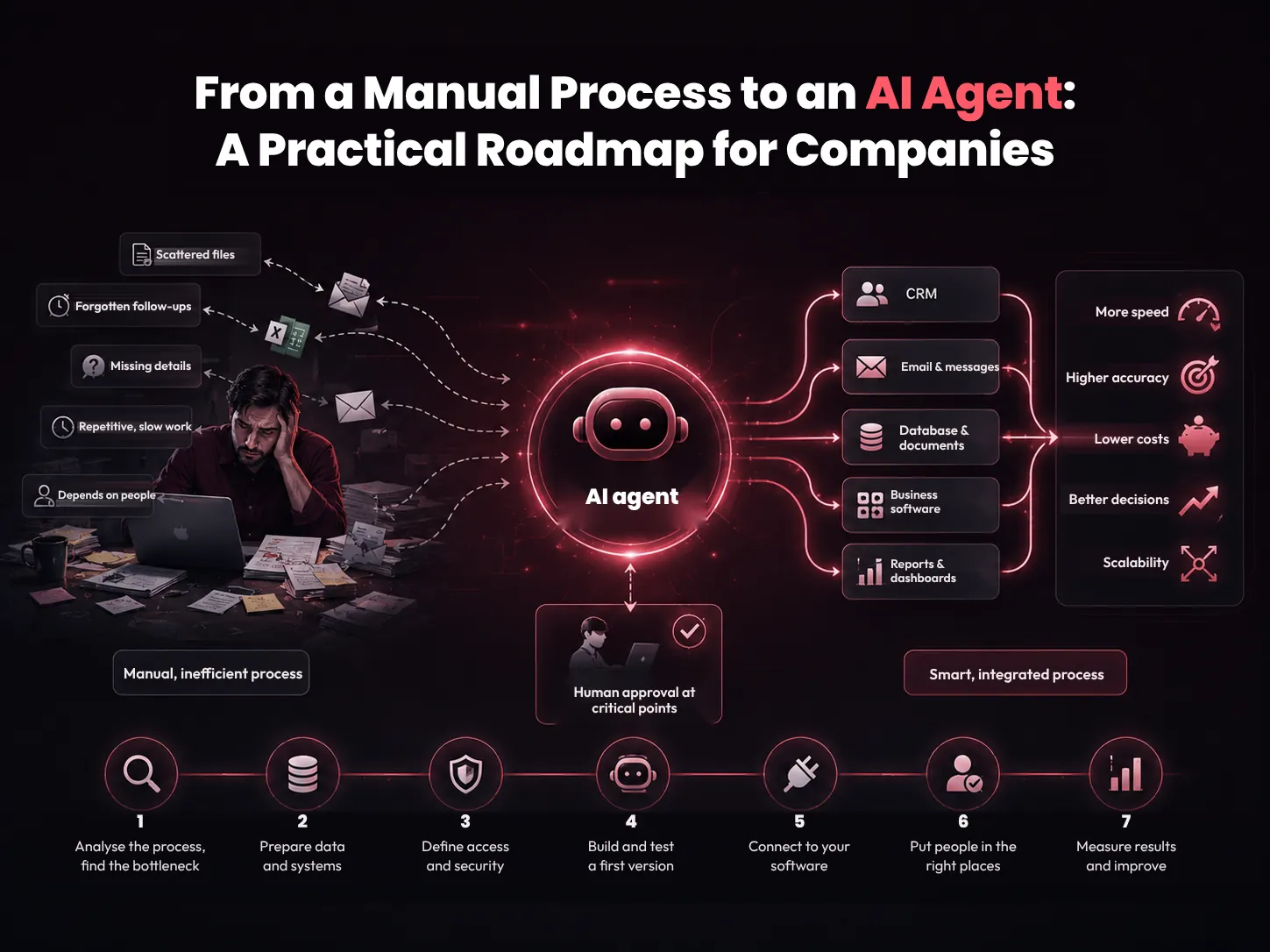
At a more advanced level, an AI agent can run a specific workflow — for example, reviewing a new lead, pulling the relevant information from the CRM, creating a follow-up task and, where needed, preparing a suitable message for a sales executive to approve.
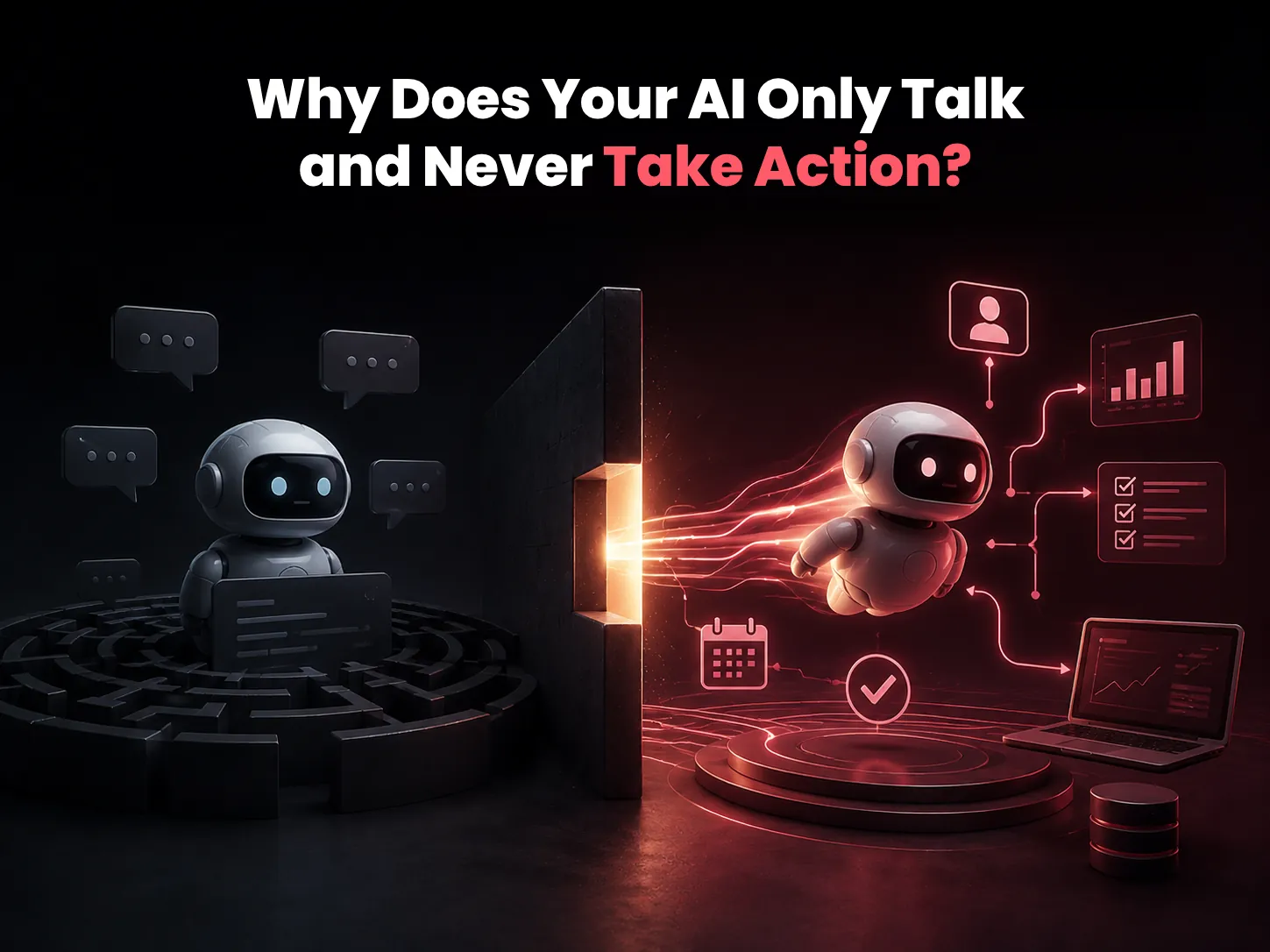
This means AI moves from being a "question answerer" to becoming part of the sales process.
3. Customer service
One of the clearest uses of AI in business is customer support.
That does not mean putting a weak chatbot in front of customers that gives an irrelevant answer to every question.
The right system can first identify what the customer is asking for, pull simple answers from the knowledge base and pass complex cases to a human agent along with a summary of the conversation.
The desired outcome is not to get rid of the support team, but to cut customer waiting times and free up staff for more complex issues.
4. Management decision-making
Managers rarely lack data.
The problem is that the data is scattered.
Sales information sits in the CRM, costs in the finance system, user behaviour on the website and team performance in other tools.
Combining software, management dashboards and AI can turn this data into answers to useful questions:
Which product has seen sales fall?
Which customers are most likely to churn?
Which marketing channel produces the highest-quality leads?
Which stage of the sales process loses the most prospects?
AI becomes valuable when it takes a manager from "seeing the data" to understanding it and acting on it.
5. Organisational knowledge
Imagine one of your most experienced team members leaves after seven years.
How much knowledge walks out of the door with them?
In many companies, the answer is worrying.
Important knowledge lives in people's heads, Word files, messaging apps, emails and scattered folders.
AI-based systems can help organise and retrieve this knowledge, so that employees can ask a question and find the answer in the company's internal sources.
This use may not be as exciting as generating images with AI, but commercially it can be far more important.
Will every company that uses AI win?
No.
And this is probably the most important part of this article.
Buying a few ChatGPT, Copilot or similar subscriptions is not an "AI transformation".
Even implementing AI without a clearly defined problem may simply create a new cost.
Three questions should be asked before choosing any tool:
Which process is currently causing problems?
Exactly which metric should AI improve?
Do we have the data and infrastructure needed to make it work?
If the answers to these questions are not clear, an AI project will quickly turn into a collection of interesting experiments with no ROI.
So the right path does not start with the technology.
It starts with the business problem.
Which businesses are most at risk of falling behind?
The risk is not the same for every industry.
But if several of the following apply to your company, you should look at AI more seriously:
- You have a large volume of repetitive work.
- A lot of customer data is generated but not analysed.
- Your sales team spends a lot of time recording and chasing information.
- Your support team handles many similar requests.
- Preparing management reports takes a long time.
- Organisational knowledge is scattered across people and files.
- Decisions are still heavily manual and dependent on individuals.
- Company growth directly requires more staff.
In these circumstances, AI can create a leverage effect.
Put simply, a good question for any manager to ask is:
If my customer numbers doubled, would I have to roughly double my headcount too?
If the answer is yes, part of the process can probably be automated.
Which businesses should not rush into AI yet?
This side of the story matters too.
If a business does not yet have clearly defined processes, its data is scattered and of poor quality, and even basic tools such as a CRM are not being used properly, adding AI will not necessarily solve the problem.
AI can make a good process faster — but it can also make a bad process descend into chaos faster.
For example, a company that does not yet know how leads should be distributed among its sales team should probably design its sales process before building a sales AI agent.
In such cases, the priorities might be:
standardising processes, integrating data, implementing a CRM, building the necessary APIs — and only then adding an AI layer.
So sometimes the best AI decision is not to implement AI for now, and to build the foundations for it first.
Off-the-shelf tools or a bespoke solution: which path is better?
For many general needs, an off-the-shelf tool is the best place to start.
If you want to summarise text, generate ideas, take meeting minutes or draft emails, you probably do not need a bespoke system.
But when AI needs to connect to internal processes, things are different.
For example, when the system needs to:
connect to the CRM, read order information, communicate with the ERP, respect employees' access levels, use the company's own data or run a multi-step workflow.
This is usually where integration or bespoke software development becomes more important.
In Zonan System's projects, the logical starting point for this kind of problem is not choosing an AI model. First, the process, the data, the bottleneck and the expected output need to be defined. Only then can you decide which parts should be solved with an off-the-shelf tool, an API, automation or bespoke development.
This approach has one important advantage: the company is not paying to "have AI"; it is investing in solving a real problem.
A practical roadmap for the next three years
If you run a business, you do not need to make your whole organisation intelligent today.
A lower-risk path can be taken in stages.
Stage one: find the processes
Make a list of activities that:
are repetitive, take a lot of time, involve a lot of data, have a high rate of human error or directly affect revenue and customer experience.
Stage two: prioritise the opportunities
For each item, ask two questions:
How big is its economic impact?
How difficult is it to implement?
Start with projects that have high impact and low to medium complexity.
Stage three: build a small pilot
Instead of a large organisation-wide project, choose one specific problem.
For example:
"Reduce the time to first response in support."
Or:
"Automatically summarise sales calls and log them in the CRM."
The pilot must have KPIs; otherwise you will not know whether AI was genuinely useful or just interesting.
Stage four: measure
Compare before and after.
Measure task time, cost, error rate, conversion rate, customer satisfaction or any other relevant metric.
Stage five: connect to core systems
If the pilot succeeds, the next step is to connect AI to the company's real software, data and workflows.
This is where AI goes from being a side tool to becoming part of operations.
Stage six: take governance and control seriously
The more authority AI is given, the more important control becomes.
Access levels, data security, activity logging, human approval, error handling and clear responsibilities should all be designed in from the start.
The aim is not to build a system that "can do anything".
The aim is to build a system that does a specific job within a defined, controllable scope.
What is the biggest mistake managers make about the future of AI?
Probably assuming there is still plenty of time.
Three years is not long in management terms.
Choosing the problem, cleaning the data, integrating systems, running a pilot, training staff and changing processes can all take months.
A company that only starts experimenting in two years' time will not necessarily be competing with a company that bought an AI tool on the same day; it may be competing with an organisation that has spent two years accumulating data, experience, workflows and practical know-how about using AI.
That gap cannot be closed overnight by buying software.
So will your business stay competitive without AI over the next three years?
For some businesses, yes.
AI is not going to invalidate every business model overnight, and not using it does not mean certain failure.
But the more precise question is this:
If your competitor can deliver the same product or service faster, more personally, with lower operating costs and with more accurate decision-making, what will your advantage be for the customer?
If you have a clear answer, you probably have a strong competitive advantage.
If you do not, it is time to review your company's processes.
Not to see "where AI could be put", but to understand where technology can create real economic advantage.
Conclusion
The future of competition is unlikely to be split simply into "companies with AI" and "companies without AI".
The more important dividing line will be between companies that confine AI to scattered tools and companies that learn to connect AI to their real data, software, people and processes.
For one company, the starting point might be sales automation. For another, it might be customer support, data analysis, knowledge management or an internal AI agent.
So you do not need to ask yourself:
"Which AI tool should we buy?"
A better question is:
"Which part of our business will become a bottleneck to growth if it does not become more intelligent over the next three years?"
If the answer is not yet clear, analysing your processes is worth more than choosing a technology. At this stage, the Zonan System team can review your existing processes, data, software and automation opportunities to establish which AI applications are genuinely justified technically and economically, and which would, for now, only add cost. Get in touch to start the conversation.
Frequently asked questions
Does every business need AI?
No. The need for AI depends on the company's processes, data volumes, number of customers and operational challenges. In some companies, fixing processes or implementing basic software is a higher priority.
What is the best place to start with AI in a company?
A process that is repetitive, costly and measurable, and that has enough data, is usually a good starting point.
Will AI reduce headcount?
For some tasks, the need for people may decrease, but in many applications AI mainly increases employee productivity and changes the nature of their work.
How is an AI agent different from a chatbot?
A chatbot mainly converses with the user, whereas an AI agent can plan several steps to achieve a goal and interact with other tools and systems.
How much does it cost to implement AI?
Costs vary enormously, from using off-the-shelf SaaS tools to developing enterprise systems, and depend on complexity, integration, data volume, security and the amount of bespoke development involved.
Do we need bespoke software for AI?
Not always. Off-the-shelf tools are enough for many general needs. When AI needs to integrate with your CRM, ERP, data or company-specific processes, bespoke development can make sense.
How can we tell whether AI will deliver ROI for our company?
Set specific KPIs before you start, then compare cost, time, error rate, revenue or conversion rate before and after implementation.
Zonan System Team
Software & AI team
Developers, designers and AI engineers at Zonan System, writing about practical AI, software development and digital business.
Need advice for your project?
Zonan System experts will guide you for free.

Comments (0)
Be the first to comment.