
What Is an AI Agent, and Why Is It More Than Just a Chatbot?
An AI agent does not just answer questions: it understands goals, makes decisions, uses tools and carries out real business processes. Here is how it differs from a chatbot.

What is an AI agent?
An AI agent is an intelligent system that can take in information, analyse a situation, make decisions and take action in order to achieve a specific goal. That action can be simple, such as answering a customer's question, or more complex, such as checking an order, analysing customer data, logging a ticket, sending an email, recommending a product, producing a report or even carrying out several steps of an organisational process.
Put simply, an AI agent does not just generate text. It does not just answer. It does not just chat. Within a defined scope, it can actually "do the work".
For example, an ordinary chatbot on an online shop might answer the question:
"How much is delivery?"
An AI agent, on the other hand, can:
- Check the customer's location.
- Identify the type of product.
- Read the delivery rules from the system.
- Calculate an approximate delivery cost.
- Check the customer's terms if they have bought before.
- Suggest completing the purchase.
- Log the request in the CRM if needed.
This is where the real difference between "answering" and "acting" becomes clear.
How is an AI agent different from a chatbot?
The biggest mistake is to think of an AI agent as just another chatbot. A chatbot is usually designed for conversation, whereas an AI agent is built to carry out a specific mission. An AI agent may look like a chatbot on the surface, but behind the scenes it has far greater capabilities.
Chatbots usually work from fixed scripts. If the user types "price", a set answer is shown; if they type "contact", a link to the contact page is sent. But as soon as a question strays outside the predefined paths, the chatbot struggles.
An AI agent can understand the goal, use different tools, connect to internal data and carry out several steps one after another. For example, if a customer asks:
"What would you recommend to increase sales for my online clothing shop?"
An ordinary chatbot will probably give a generic piece of text about marketing. A good AI agent, however, can ask the user a few questions, review the state of the website, categorise likely problems in the sales funnel, give practical recommendations and finally log a consultation request for the sales team.
Why does this difference matter to businesses?
Because many businesses are not just looking for faster responses. They face deeper problems, such as leads not being followed up, repetitive answers in customer support, customer data going unanalysed, weak SEO content production, long internal processes and heavy reliance on people for repetitive tasks.
In these circumstances, a simple chatbot only improves the surface. An AI agent can genuinely improve part of the process.
Imagine a service company that receives dozens of messages from potential customers every day. Some just have general questions. Some are ready to buy. Some need advice. Some need to be referred to the technical team. If every one of these messages is reviewed manually, it takes a great deal of time and the risk of losing customers goes up.
An AI agent can categorise the messages, gauge how ready each customer is to buy, give an appropriate first response, gather the necessary information and pass only the more important cases to the human team. That means less pressure on the team, faster response times and a lower chance of losing leads.
What exactly can an AI agent do?
The uses of an AI agent are not limited to website support. Depending on the type of business, its data, its systems and its goals, an agent can be used in many different areas.
1. Intelligent customer responses
The first and simplest use of an AI agent is answering customers. The difference from a chatbot is that the answers are not simply chosen from a handful of pre-written texts. The agent can understand the customer's question, find the relevant information in the knowledge base and give a more accurate answer.
For example, if a customer asks:
"For a company like ours with 20 staff, is an off-the-shelf CRM or bespoke software the better option?"
The agent can tailor its answer to the size of the company, the type of need, the budget, the sales process and the complexity of its operations. This kind of answer is far more valuable than a generic reply.
2. Content creation and optimisation
An AI agent can play an important role in producing SEO-optimised content. That does not mean churning out an article without any analysis. A content agent can research the topic, identify the search intent, design the article structure, group keywords, create FAQs, suggest internal links and produce different versions of the content for the website, LinkedIn and Instagram.
For businesses that want to grow on Google, this is a very important use. Content production is not just writing text; it needs to fit into a pillar-and-cluster structure, meet the user's needs and link to other pages on the site.
3. Supporting the sales team
Sales is one of the most significant uses of AI agents. Many sales teams spend a lot of time answering repetitive questions, carrying out initial customer screening and doing simple follow-ups. An agent can take on part of this work.
For example, it can:
- Analyse the customer's message.
- Determine whether the customer is cold, warm or ready to buy.
- Gather initial information.
- Recommend suitable services.
- Schedule a consultation.
- Send a summary of the conversation to the sales team.
This means the sales team can focus on serious prospects instead of getting bogged down in repetitive tasks.
4. Internal support for teams
AI agents are not only for external customers; they can be used inside the organisation too. For example, employees can ask an internal agent about processes, documentation, company policies, projects or the status of work.
In companies where information is scattered, this is extremely valuable. Instead of everyone sending several messages to find a file or a simple answer, the agent can respond using the internal knowledge base.
5. Data analysis and reporting
Many businesses have data but do not use it. Orders, user behaviour, calls, messages, sales, website traffic and campaigns generate information every day. But if that data is not analysed, it remains nothing more than numbers.
An AI agent can connect to different systems and produce reports that are easy to understand. For example, it can tell you:
- Which product sells best?
- Which page on the website has the lowest conversion rate?
- Which campaign brought in the highest-quality leads?
- Which customer question comes up most often?
- Which process wastes the most time?
This is exactly where Zonan System can help, by designing bespoke agents and connecting them to a business's real systems.
How does an AI agent work?
To put it simply, an AI agent usually has several main parts.
First, it needs to receive input. This might be a user's message, website data, a file, a form, an email, a ticket or CRM data.
Second, it needs to understand the subject — that is, work out what the user wants and which category the request falls into.
Third, it needs access to the right knowledge or tools. For example, if the user asks about the price of a service, the agent needs access to service information. If they ask about the status of an order, it must be able to read the order status from the system.
Fourth, it needs to make a decision — not just answer, but work out what the next step should be.
Fifth, it needs to take action. That action might be sending a reply, recording information, building a report, sending an email, creating a ticket or handing over to a person.
So an AI agent is a combination of a language model, data, tools, decision logic and connections to other systems. The more precisely and securely those connections are designed, the more useful the agent becomes.
When does your business need an AI agent?
Not every business needs a complex agent from day one. But if you recognise several of the signs below, an AI agent could well be valuable for you.
If your team spends a lot of time giving repetitive answers, an agent can handle some of them.
If you receive a lot of leads but do not follow them up consistently, an agent can categorise and prioritise them.
If your website has a lot of content but users struggle to find answers, an agent can act as an intelligent guide.
If you have many internal processes that are still done manually, an agent can take on part of the automation.
If you want to make your SEO content production more systematic, an agent can help with research, structuring and repurposing content.
However, if your core business processes are not yet clearly defined, your data is scattered and disorganised, or you have no clear goal for using AI, it is better to analyse your processes and needs before building an agent.
Common mistakes in designing an AI agent
Many AI projects fail because they are not defined properly from the start. Managers assume that adding an AI tool to the website will transform everything. The reality is that an AI agent without proper design can create new problems instead of solving existing ones.
1. Starting with the tool instead of the problem
Some businesses begin by asking which AI tool they should use. The right question is: what problem are we trying to solve?
If the problem is not clearly defined, even the best tool will not deliver good results. You need to be clear about the goal: reducing pressure on support, increasing sales, categorising leads, producing content, analysing data or automating internal work.
2. No data and no knowledge base
Without accurate knowledge, an agent cannot give accurate answers. If information about your services, prices, processes, FAQs, policies and documentation is not ready, the agent will be forced to produce generic answers.
That is why a knowledge base should be built before an AI agent is designed.
3. Complete trust without human oversight
An AI agent should work within a defined scope. For sensitive decisions — such as final pricing, legal matters, financial information or significant commitments — there must be a route for escalation to a person.
A good agent is not meant to remove people entirely; it is meant to reduce repetitive work and raise the quality of decision-making.
4. Not designing an escalation path
If the agent cannot solve a problem, it needs to know when to hand over to a person. If that route is not designed, the user gets stuck in the conversation and ends up with a worse experience than before.
5. Ignoring security and data privacy
When an agent is connected to a CRM, orders, customer information or internal systems, security is extremely important. It must be clear which data it can access, what it is allowed to do and what it must not do.
The role of AI agents in SEO and content production
An AI agent can help with a website's SEO — but that does not mean simply producing lots of articles. Mass-producing weak content is dangerous for a website, even if it is done with AI.
The right use of an AI agent in SEO is to make the process of producing high-quality content more systematic. For example, it can:
- Organise topics into pillars and clusters.
- Identify the search intent of each article.
- Suggest suitable headings.
- Create FAQs.
- Suggest internal links.
- Review older articles for updating.
- Prepare content summaries for social media.
In this role, the AI agent does not replace your SEO strategy; it makes executing it faster and more precise.
For example, if Zonan System wanted to build topical authority around "AI in business", a content agent could help make sure every article links to related articles, the content structure stays consistent and the site's growth does not become fragmented.
Off-the-shelf or bespoke AI agent: which is better?
The answer depends on the needs of the business. Off-the-shelf tools are good for getting started quickly. If you simply want a basic assistant on your website to answer questions, an off-the-shelf tool may be enough.
But if you want the agent to connect to your internal systems, understand your business's own information, carry out real processes or work with your CRM, website, sales panel, support system and management dashboard, a bespoke agent is usually the better choice.
A bespoke agent can be designed around your real needs. For an online shop, for example, the focus might be on product recommendations and order support. For a service company, the focus might be on identifying customer needs and logging consultation requests. For a manufacturer, it might be on internal reporting and process management.
Zonan System can play an important hands-on role here, because designing a bespoke agent is not just about writing prompts; it requires process analysis, architecture design, integration with your software, data security and operational testing.
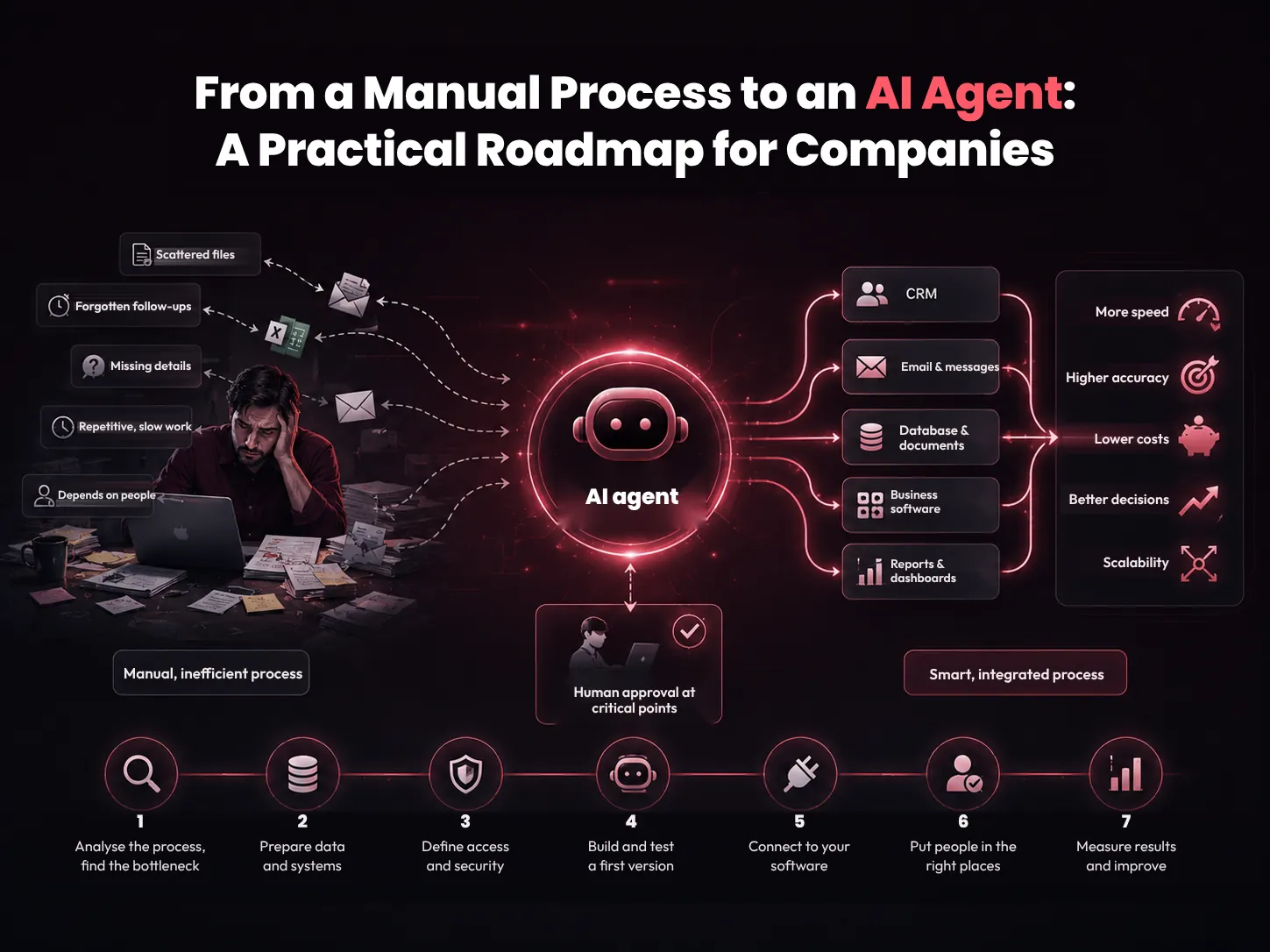
Steps to implementing an AI agent in your business
For an AI agent to deliver real results, it is best to implement it in stages.
1. Identify the problem
First, you need to establish which part of the business wastes the most time or money. Support? Sales? Content production? Reporting? Customer follow-up?
2. Define the goal
The goal should be measurable. For example:
- A 30 per cent reduction in repetitive support messages
- Faster response times for leads
- Less time spent producing content briefs
- A higher conversion rate on consultation forms
3. Prepare the data
Information about your services, FAQs, articles, documentation, processes and any other necessary data should be gathered and organised.
4. Design the workflow
You need to define what the agent should do in each situation, when it should ask a question, when it should answer and when it should hand over to a person.
5. Connect the tools
Where needed, the agent should be connected to your website, CRM, email, ticketing system, dashboard or internal panel.
6. Test and improve
No good AI agent is perfect from day one. It needs to be tested against real scenarios and refined over time.
Checklist before building an AI agent
Before you start designing an agent, answer these questions:
- Exactly what problem is it meant to solve?
- Who will use the agent?
- Should the agent only answer, or take action as well?
- What data does it need?
- Which systems does it need to connect to?
- What must it not do?
- When should it hand over to a person?
- How will the project's success be measured?
- Is there a sufficient knowledge base?
- Is the internal team ready to use the agent's output?
If the answers to these questions are not clear, it is better to begin the project with a consultation and analysis phase rather than by buying a tool.
The future of AI agents in business
AI agents are gradually moving from side tools to becoming part of companies' core working infrastructure. Just as having a website was once an advantage and is now a necessity for many businesses, using intelligent agents will gradually become normal in many areas.
But the winners will not simply be those who adopt AI first. The winners will be the businesses that understand more precisely where, why and how to use AI.
A good AI agent must solve a real problem. It must be connected to the right data. It must improve the user experience. It must be controllable. It must fit in with the business's processes. If these conditions are not met, the agent will be nothing more than an attractive but low-impact tool.
Conclusion
An AI agent is not just a simple chatbot. A chatbot is usually designed to answer, whereas an AI agent can understand a goal, make decisions, use tools and carry out part of a real process.
That is where the real value of AI agents lies for businesses. This technology can make support faster, sales more organised, content production more structured and data more usable, and it can take some of the repetitive work off your teams.
Building a successful AI agent, however, requires careful analysis. The problem must be clearly defined, the data must be ready, the workflows must be designed and the agent must be deployed in the right place. If you are planning to design a bespoke agent for your website, sales, support, SEO or internal processes, the Zonan System team can work alongside you on requirements analysis, solution design and technical delivery. Get in touch to discuss your project.
Frequently asked questions
What is an AI agent?
An AI agent is an artificial intelligence system that can take in information, make decisions and take action in order to achieve a specific goal. Unlike a simple chatbot, an agent does not just answer; it can carry out part of a business process.
What is the difference between an AI agent and a chatbot?
A chatbot is mostly designed for conversation and limited answers, whereas an AI agent can connect to different data sources and tools, analyse the situation, make decisions and take actions such as logging a ticket, sending an email or analysing information.
Does every business need an AI agent?
Not necessarily. If a business has repetitive processes, a high volume of messages, data worth analysing or a need for automation, an AI agent can be useful. But if processes are not yet clearly defined, it is better to analyse and structure them first.
Can an AI agent replace people?
In most cases, the aim is not to replace people entirely. An AI agent is best used for repetitive, simple and time-consuming tasks, while sensitive or complex cases are handed over to people.
How long does it take to build an AI agent?
The implementation time depends on the complexity of the project. A simple agent for answering website queries can be ready relatively quickly, but an agent that connects to a CRM, sales panel or internal system needs more analysis, design, development and testing.
How does an AI agent help with SEO?
An AI agent can help with topic research, designing article structure, suggesting internal links, creating FAQs, reviewing older articles and repurposing content. However, content quality and SEO strategy should still be overseen by people.
Zonan System Team
Software & AI team
Developers, designers and AI engineers at Zonan System, writing about practical AI, software development and digital business.
Need advice for your project?
Zonan System experts will guide you for free.


Comments (0)
Be the first to comment.