
Why Isn't Your CRM Increasing Sales? 7 Signs You Need a Sales AI Agent
Your CRM records leads, but they are still forgotten, follow-ups slip and reps don't know where to focus. Here are seven signs it's time to add a sales AI agent that prioritises, reminds and recommends the next best action.

Imagine it is Monday morning. The sales manager opens the CRM and is greeted by something that looks promising on paper: 380 leads, dozens of open opportunities, a number of logged meetings and several customers who were due a follow-up call.
But on closer inspection, the picture is rather different. Some leads have been waiting three days for a call. Several simply say "follow up". A few customers have received a quote, yet nobody knows why they have not bought. One sales rep has logged every call in full; another has recorded almost nothing. Worse still, nobody can say with confidence which customers should be called today to give the best chance of a sale.
The CRM is there. The data is there. But sales have not grown the way everyone expected.
This situation is familiar to many companies, because having a CRM does not necessarily mean having an intelligent sales process. A CRM can store information and bring order to the process, but in many systems a person still has to review the data, work out the priorities, find the right moment to follow up and take the next step.
This is where a sales AI agent comes in — not as a replacement for the sales team, but as an intelligent layer that moves the CRM from being "a place to record information" towards being "a system for making decisions and taking action".
Below we look at seven signs that your sales problem probably will not be solved by buying a new CRM, and that it is time to think about making your sales process smarter.
What exactly does a CRM do, and why can it not guarantee sales on its own?
A CRM (Customer Relationship Management system) helps a business keep customer details, calls, sales opportunities, negotiations and communication history in one central system. When it is implemented properly, the sales manager has a far more orderly view of the sales funnel instead of scattered spreadsheets, reps' notebooks and messages lost in WhatsApp.
But there is a common misconception: that rolling out a CRM will, by itself, increase sales.
A CRM is really more like infrastructure. If the sales process is not defined, the data is incomplete, reps do not carry out follow-ups, or there is no mechanism for identifying important leads, the same old chaos simply moves into a new piece of software.
For example, a CRM can tell you that you have 150 open opportunities. But the more important question is: which five opportunities should a sales rep tackle first today?
Answering that kind of question is exactly where data analysis, automation and artificial intelligence can create real value.
What is a sales AI agent, and how is it different from a CRM?
A sales AI agent is an AI-powered software agent that, based on data, business rules and defined goals, can analyse information, recommend decisions and take action within clearly set limits.
This is the key difference from simple automation.
With traditional automation, we typically say: "If three days have passed since the last call, create a reminder."
An intelligent agent, however, can take far more factors into account: what product does this customer want? What interactions have they had before? How did the last conversation end? What stage of the buying journey are they at? What is the likely value of the deal? Does their behaviour resemble that of customers who have bought before?
Based on this information, it can then suggest the next action or carry out part of the workflow, within its permitted scope.
So the aim is not to get rid of the CRM. On the contrary, the CRM can be one of the agent's most important data sources. The point is to add the ability to analyse and act on the data you already have.
Sign one: your CRM is full of leads, but nobody knows who to call first
One of the clearest signs is when the number of leads has increased but the sales team's performance has not grown in line with it.
Imagine a B2B services company receives 500 leads in a month from its website, advertising, trade shows and referrals from existing customers. The sales reps cannot call everyone at once, so some choices are made based on when the lead arrived, or simply on the rep's personal judgement.
The result is predictable: a rep may spend 20 minutes on a lead who is merely browsing the market, while another customer with a clear budget and a defined need has been waiting hours for a reply.
How does AI prioritise leads?
In a well-designed system, lead scoring can combine data such as lead source, type of enquiry, company size, previous behaviour, pages viewed, conversation history and stage in the sales funnel.
The AI agent can then prioritise opportunities and tell the rep which ones are likely to be worth following up more quickly.
In this model, the CRM no longer just tells you "which leads we have"; the system helps you understand which leads you should focus on first.
Sign two: customers wait until a sales rep finds time to follow up
A lead fills in a consultation request form at 10 a.m. The sales rep is in a meeting. After the meeting they have two more calls, then get caught up preparing a quote. At 4 p.m. they remember they need to check the CRM.
The delay may seem minor, but the customer will not necessarily wait for you in the meantime.
They may well have filled in forms for two competitors, and one of them may get in touch first.
An AI agent can analyse a lead the moment it arrives, gather initial information, identify the right owner and — if a workflow has been defined — send an initial response or create a follow-up task.
The goal is not to hand the entire sales negotiation over to a machine. In many complex sales, human contact remains essential. The goal is to shorten, as far as possible, the gap between "the customer expressing a need" and "the response process starting".
And that brings us to the next problem: follow-ups that never happen at all.
Sign three: a large share of follow-ups are forgotten
"Call back on Tuesday."
This may be one of the most common phrases in sales — and also one of the points where the most opportunities are lost.
A sales rep might not log the next call, might see the reminder but push it back because of more urgent work, or might even forget after a few days what the last conversation was about.
Automation can create reminders, but an AI agent can go one step further and bring the context of the conversation into the decision.
For example, it might remind the rep:
"This customer received a quote three days ago, asked about delivery times and was due to confirm their finance director's decision today."
This kind of summary means the rep does not have to reread several notes and the communication history before making the call.
As a result, follow-up turns from a memory-dependent task into a systematic process.
Sign four: the sales manager has data, but no answers to the important questions
One of the strangest situations is when a company has thousands of records in its CRM, yet the sales manager still needs a weekly meeting to answer the key questions.
Why were sales down this month?
Which opportunities are most likely to close?
At which stage of the funnel do most customers drop out?
Which customer objection comes up most often?
Which reps have the most overdue follow-ups?
A traditional CRM may show some of this information in reports, but AI can help far more with analysing patterns in large volumes of data, notes and conversations.
For instance, if a large number of lost opportunities contain phrases such as "price too high", "needs manager approval" or "delivery time", a systematic analysis of this data can reveal an important pattern for the sales manager.
At this point, the CRM changes from a tool for recording the past into a tool for better understanding the present.
Sign five: sales reps spend much of their day on non-sales work
A sales rep is hired to negotiate, understand customer needs, build trust and move deals forward — but their day-to-day reality may look quite different.
Logging call notes, updating opportunity stages, setting reminders, digging out customer history, writing repetitive messages, summarising meetings and preparing reports for their manager can eat up a significant portion of their time.
Some of these activities add little human value and are good candidates for automation.
Depending on the company's infrastructure, a sales AI agent can help with summarising conversations, completing CRM records, suggesting replies, creating tasks, categorising enquiries and preparing reports.
The important point is that not everything should be automated simply because it can be. Sensitive negotiations, special discounts, major contracts and decisions with serious financial or legal consequences need an appropriate level of human oversight.
Successful intelligent automation means freeing people from repetitive work so they have more time for the tasks that genuinely require human judgement.
Sign six: the customer experience depends on the sales rep, not the system
In some companies, a customer who reaches an experienced rep has an excellent experience. The same customer, if they reach a newcomer, may receive a different answer or be followed up later.
This means the quality of the sales process depends on individuals.
In a small team this dependency may be manageable, but as the business grows it becomes a problem.
An AI agent can make part of the organisation's sales knowledge available to the whole team. For example, based on product information, company guidelines, customer history and the sales playbook, it can suggest a reply or the next action to the rep.
This does not mean every rep will start sounding like a robot; rather, the team gains a "shared memory and assistant".
For businesses with a specialised sales process and several different systems, an off-the-shelf solution is not always enough. In such cases, Zonan System can first analyse the real sales flow, the existing CRM, the points where leads are lost and the options for connecting systems, and then establish whether ready-made automation will do the job or whether an AI agent and custom development are needed.
Sign seven: your CRM tells you what happened, but not what to do now
This may be the most important difference between a record-keeping CRM and an intelligent sales system.
The CRM says:
"The customer called four days ago."
But the sales manager needs the answer to a different question:
"What is the best action right now?"
Should we call? Send a message? Make a new offer? Wait a few days? Hand this opportunity to another rep? Or is the likelihood of a purchase so low that the team's energy would be better spent elsewhere?
AI will not always give a definitive, error-free answer. But by analysing the available data, it can offer recommendations that are worth considering.
Moving from record keeping towards decision support and action is precisely the shift that many sales teams expect from intelligent systems.
How does a sales AI agent work alongside a CRM in practice?
It is best not to think of an AI agent as a separate, magical piece of software. Real value is created when the agent is connected to the components of the sales process.
The CRM holds customer and opportunity data. The website generates new leads. The phone and messaging systems produce communication data. An ERP may hold order or stock status, and the finance system records payment information.
Within its permitted level of access, the agent can connect this information and run a defined workflow.
A simple scenario might look like this:
A lead arrives via the website; their details are recorded in the CRM; the system identifies the type of enquiry; the lead is scored; the right rep is assigned; a summary of the information is given to them; a follow-up time is scheduled; and if no action is taken, the system raises another alert or escalates it according to the defined rules.
In this scenario the AI is not the salesperson; it makes the sales process more organised, faster and more data-driven.
Does every company with a CRM need a sales AI agent?
No — and this is an important point.
If your company receives a limited number of leads each day, the sales process is simple, follow-ups happen consistently and the sales manager has sufficient visibility of the pipeline, adding a complex agent probably will not create much economic value.
Your problem may not even be technology at all.
If reps have not been adequately trained, the sales offer is not compelling, lead generation is weak or the sales stages have not been defined, AI will not solve these fundamental problems.
But when lead volumes have grown, you have several sales channels, follow-ups are slipping through the cracks, a lot of data has accumulated in the CRM and the team spends a great deal of time on repetitive activities, exploring an AI agent becomes much more sensible.
That is why the starting point of the project should not be "build us some AI". A better question is:
At which point in the sales process are we losing time, data or revenue opportunities?
Where should you start when implementing a sales AI agent?
A common mistake is for a company to try to make the entire sales function intelligent from day one. A lower-risk approach is to start by choosing a single use case with clear business value.
For example:
"Reducing leads that receive no follow-up"
or:
"Prioritising sales opportunities for reps' daily call lists."
Next, you need to establish what data is required for that decision, where that data lives and how good its quality is.
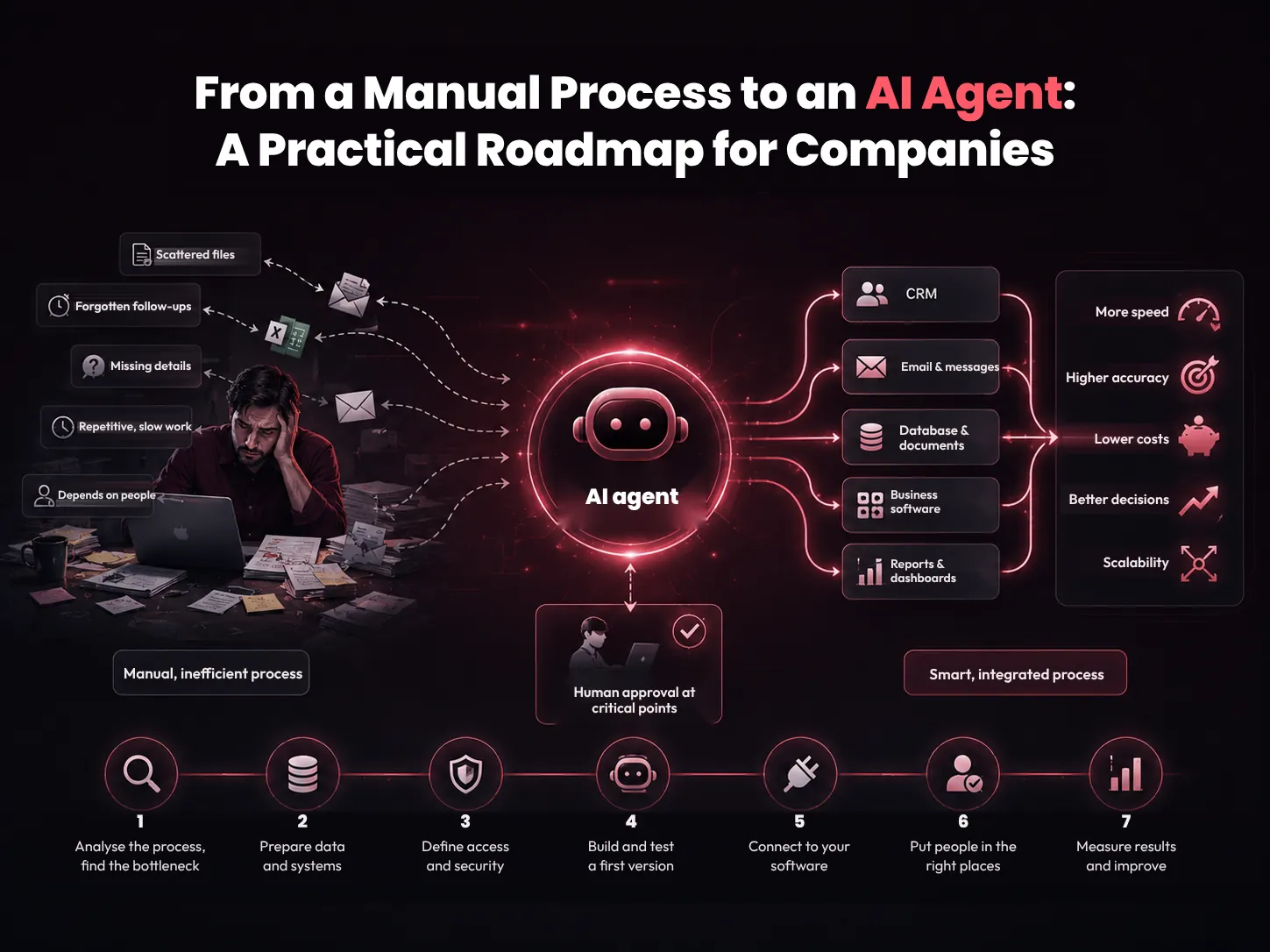
The following step is to define the workflow and the boundaries of the agent's authority. What should it only recommend? What can it carry out automatically? Under what conditions is approval from a rep or manager required?
After that, you can run a limited version on part of the process and compare the results against KPIs such as time to first response, percentage of follow-ups completed, lead conversion rate, sales cycle length and the amount of manual work reps do.
In projects like these, the Zonan System team focuses first on analysing the sales process and its points of friction, because a good agent running on a bad process simply runs that bad process faster.
Check this list before buying a new CRM
If you feel your current CRM is not delivering the results you want, review the following before migrating to another system:
- Do all leads enter the CRM centrally?
- Is there a clear owner for every lead?
- Is time to first response measured?
- Are overdue follow-ups visible?
- Are the reasons for lost opportunities recorded?
- Can you distinguish higher-value leads from the rest?
- Do reps spend a lot of time on manual data entry?
- Can conversation data be analysed?
- Is the CRM connected to your website, phone system, ERP or other key systems?
- Does the sales manager know which opportunities need urgent action today?
If the answer to several of the last items is "no", the issue is probably not just your choice of CRM. The architecture of the entire sales process needs to be reviewed.
What are the common mistakes when using AI for sales?
The first mistake is starting a project without reliable data. If the CRM is full of incomplete information, duplicate records and incorrect stages, the intelligent model will make decisions based on that same poor data.
The second mistake is over-automation. Sending automated messages without regard to the customer's context can create a cold or even irritating experience.
The third mistake is having no human in the loop. For sensitive decisions, it must be clear when the agent only makes recommendations and when a person makes the final call.
The fourth mistake is ignoring security and access levels. A sales agent may have access to customer information, prices, contracts or commercial data, so access control, activity logging and data retention policy are part of the system design — not something to be dealt with later.
And the final mistake is not measuring results. If you do not have clear KPIs before and after implementation, even an impressive system cannot prove that it has genuinely created business value.
Conclusion: perhaps your CRM is not short of features, but of "intelligent action"
If you have a CRM but sales have not increased, do not jump to the conclusion that you need to buy a different one.
First, look at what happens between "a lead arriving" and "becoming a customer".
If leads are not prioritised, responses are slow, follow-ups are forgotten, the sales manager cannot extract insight from the data, reps are bogged down in repetitive work and the system merely records past events, it is probably time to think about an intelligent layer on top of your sales process.
A sales AI agent is valuable when it solves a real, measurable problem — not when it is implemented simply to add AI to the organisation.
In projects like these, Zonan System can start by analysing the existing process: what data your current CRM holds, exactly where leads are being lost, which activities can be automated and where human decision-making remains essential. Only after this analysis can a sound decision be made about connecting AI to your CRM, developing a custom agent or reworking your workflows.
If you have a CRM but are not sure whether the problem lies in the software, the sales process or the way leads are followed up, a proper analysis of the journey from lead to sale can pinpoint where value is really being lost before you make any new investment. Get in touch with us to talk it through.
Frequently asked questions about sales AI agents and CRM
Can an AI agent replace a CRM?
In most scenarios, no. The CRM is the main source of customer and opportunity data, and an AI agent can operate as an intelligent layer alongside it. The agent's main value lies in analysing information, recommending actions and running defined workflows.
What is the difference between a sales AI agent and CRM automation?
Traditional automation usually relies on fixed rules such as "if X happens, do Y". An AI agent can analyse context and various kinds of data in addition to rules, and choose a more appropriate recommendation or action on that basis.
Can an AI agent automate customer follow-ups?
Yes, some follow-ups can be automated, but the level of automation should be determined by the type of sale and the sensitivity of the relationship. In complex negotiations and important decisions, human oversight remains essential.
Which companies benefit most from a sales AI agent?
Companies with high lead volumes, multiple inbound channels, a relatively complex sales cycle, an actively used CRM and a large number of repetitive activities usually find more use cases for an agent.
Do we need to replace our current CRM to deploy an AI agent?
Not necessarily. If your current CRM has an API or suitable integration options, in many projects intelligent capabilities can be connected to the same infrastructure. The final decision depends on the system architecture and the needs of the business.
How much does it cost to implement a sales AI agent?
There is no fixed figure. The cost depends on the number of integrations, data quality, workflow complexity, the AI model, the level of automation, security requirements and the need for custom software development. That is why the process should be analysed before any cost estimate is made.
Zonan System Team
Software & AI team
Developers, designers and AI engineers at Zonan System, writing about practical AI, software development and digital business.
Need advice for your project?
Zonan System experts will guide you for free.


Comments (0)
Be the first to comment.